

The warehouse racking industry projects growth to $14 billion by 2033 with a 4.12% CAGR. Warehouse rack systems provide critical storage infrastructure for businesses requiring maximum capacity and operational efficiency. The pallet racking market specifically shows 9.31% CAGR growth through 2033.
Warehouse racking systems increase inventory capacity by two to three times the existing square footage. Implementation costs range significantly based on system configuration and scale. High-quality warehousing rack systems for larger operations cost $100,000 or more. Storage density directly affects pricing. Selective racking offers lower density at reduced cost. Pallet flow racking provides higher density but requires a premium investment.
This guide covers warehouse racking types, design principles, and selection criteria for business storage requirements. Topics include selective pallet racks, cantilever systems, and methods to balance accessibility, storage density, and budget constraints for warehouse storage solutions.
Warehouse Racking Systems: Function and Business Value
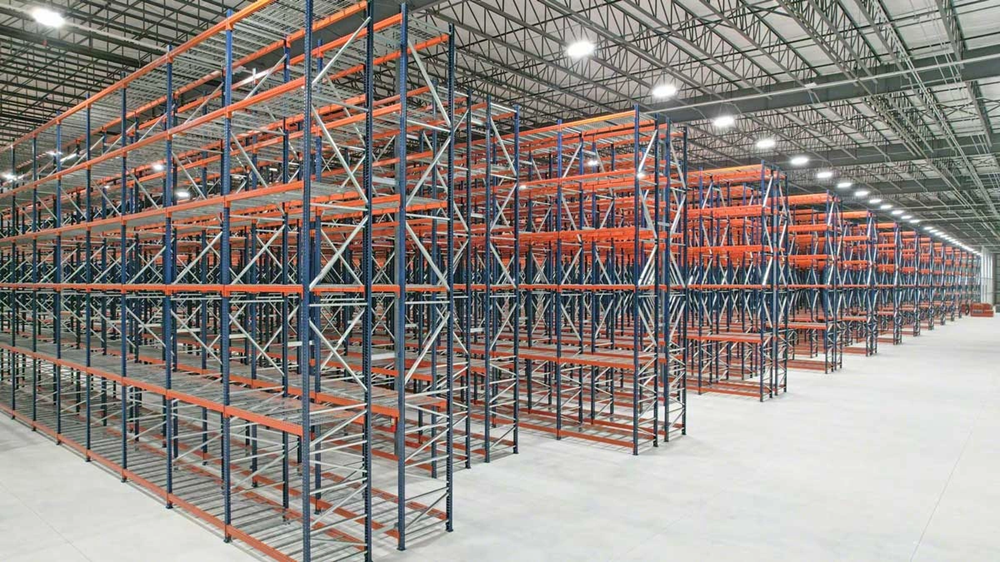
Warehouse racking systems form the structural foundation of modern storage operations. These metal frameworks organize inventory efficiently through vertical storage methods.
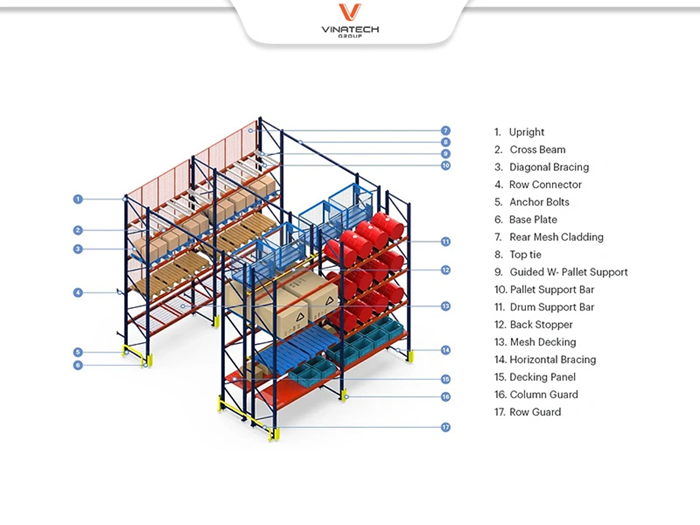
Warehouse racking system components
Warehouse racking systems use metal structures for storing materials on pallets or skids across horizontal rows with multiple vertical levels. Storage facilities have utilized these systems since the Second World War across warehouses, manufacturing facilities, retail centers, and distribution operations. Warehouse racking, also called pallet racking, stores pallets on metal shelves that maximize vertical space.
Standard system components include:
- Upright frames – Floor-to-ceiling vertical beams with holes for adjustable shelf heights
- Cross-beams – Horizontal supports creating shelf levels
- Decking – Cross-beam reinforcement using wire, perforated steel, solid steel, or wood materials
- Safety features – Post protectors at frame bases and safety panels or nets securing pallets
Warehouses use forklifts or material handling equipment for pallet loading and unloading operations. System selection depends on operational requirements, storage needs, and workflow processes.
Space optimization and inventory management benefits
Warehouse racking systems maximize space utilization through vertical inventory stacking rather than horizontal expansion. Businesses avoid costly warehouse expansions while storing more products within existing floor areas. This reduces clutter and improves workflow efficiency.
Structured organization methods enhance inventory management through systematic arrangement. Products become easily accessible and identifiable. Search times reduce by 30% while order fulfillment errors decrease. Organized structures enable faster picking and packing, streamlining operations and improving productivity.
Modular pallet racking systems provide expansion flexibility. Growing businesses adapt storage configurations without complete system replacement. This benefits operations with seasonal inventory fluctuations or expanding product lines.
Safety improvements result from proper item storage and floor clearance. Secure frames and locking mechanisms maintain structural integrity while protecting inventory and personnel.
Inventory management methodologies receive direct support through racking configurations. Systems accommodate last-in-first-out (LIFO) or first-in-first-out (FIFO) processes. This suits businesses with varying inventory turnover rates and product shelf-life requirements.
Space utilization reduces real estate expenses through minimized additional storage facility needs. Advanced warehouse management technologies with racking systems reduce stockouts and overstocks by over 20%.
System versatility accommodates diverse storage requirements. Selective pallet racks store varied inventory while cantilever racks handle long items like piping or lumber. Customization ensures optimal space utilization regardless of inventory characteristics.
Warehouse Racking System Types: Load and Access Methods

Warehouse rack systems are classified by product loading and retrieval methods. Each system provides specific advantages based on inventory characteristics, turnover requirements, and space limitations.
Selective Pallet Racking (FIFO)
Selective pallet racking provides the most widely used warehouse storage configuration. This system enables direct access to every pallet without relocating other items, suitable for warehouses with numerous SKUs. The design uses upright frames and horizontal beams supporting shelves for first-in, first-out (FIFO) inventory management. This configuration ensures older stock moves first, essential for businesses with perishable goods or expiration dates.
Selective racking offers flexibility and accessibility but provides lower storage density compared to alternative systems. This configuration suits operations prioritizing product selectivity over maximum space utilization.
Drive-In and Drive-Through Racking (LIFO/FIFO)
Drive-in and drive-through racking appear similar but serve different inventory management requirements [15]. Both systems maximize storage density by eliminating aisles, but operational differences affect warehouse efficiency.
Drive-in racking uses single entry/exit points, creating LIFO (last-in, first-out) environments where forklifts enter structures, place pallets on support rails, and reverse out. This design works for non-perishable goods and products without expiration dates, including construction materials or metal products.
Drive-through racking provides access points on opposite sides, enabling forklifts to travel through the system. This creates FIFO rotation patterns suitable for date-sensitive or perishable inventory. Drive-in requires more maneuvering, while drive-through offers smoother throughput.
Push-Back Racking (LIFO)
Push-back racking provides high-density storage with better selectivity than drive-in systems. This configuration uses inclined rails with nested carts or rollers. New pallets push previous pallets deeper during loading; gravity returns the next pallet to the pickup position during retrieval.
Push-back systems follow LIFO inventory methods, suitable for warehouses with medium-turnover goods and limited SKU variety per channel. These systems typically store 2-6 pallets deep and require single working aisles, maximizing floor space utilization.
Pallet Flow Racking (FIFO)
Pallet flow racking represents high-density storage with efficient throughput capabilities. The system uses slightly sloped channels with rollers allowing pallets to slide automatically from loading to unloading points. This gravity-driven movement enables FIFO inventory management without intermediate aisles.
These racks accommodate up to 30 pallets in depth, though deeper channels may reduce vertical storage capacity due to required 4% inclination angles. Separate loading and unloading aisles eliminate traffic interference, making pallet flow suitable for warehouses storing dated goods with high turnover requirements.
Cantilever Racking for Long Items
Cantilever racking uses load-bearing arms bolted to vertical columns, creating unobstructed frontal access for lengthy or irregularly shaped items. This design accommodates furniture, lumber, pipes, steel tubing, and other bulky materials unsuitable for conventional pallet racks.
Cantilever systems are available in single-sided (wall-mounted) or double-sided configurations, eliminating vertical supports between levels to maximize horizontal space utilization. Adjustable arm spacing allows customization based on specific product dimensions.
Carton Flow and Shelving Systems
Carton flow systems function like pallet flow racks but are designed for smaller, lighter items. These gravity-fed solutions convert static shelving into dynamic storage that maintains products flowing to picking positions, improving order fulfillment efficiency.
Carton flow operates on FIFO principles, reducing picker travel time while ensuring proper inventory rotation. Many warehouses integrate these systems with conventional pallet racking, using upper levels for pallet storage and lower levels for case picking. This approach optimizes space utilization across diverse inventory profiles.
Warehouse Racking System Design for Operational Efficiency
Efficient warehouse racking system design requires precise measurements and planning. The design process considers multiple factors to maximize storage capacity while ensuring safe operations.
Pallet Dimensions and Weight Specifications
Accurate pallet measurements provide the foundation for proper racking system design. Standard pallet rack systems accommodate two pallets stored side-by-side in each bay. Configuration requirements:
- 96″ long beam: 6″ between pallets, 5″ on either side, 4-6″ above for liftoff
- 92″ long beam: 4″ between pallets, 5″ on either side, 4-6″ above for liftoff
Storage bays measure 42″ or 48″ deep for various pallet sizes. Frame depth calculation: subtract 6″ from pallet depth. 48″ pallets require 42″ frame depth [3]. This calculation ensures proper support and accounts for potential overhang.
Load weight determination is critical for selecting beam and upright capacities. Measure the heaviest anticipated load to ensure system capacity accommodates maximum weights throughout the lifecycle.
Aisle Width Selection Based on Equipment Requirements
Aisle width affects warehouse efficiency, safety, and storage capacity. Material handling equipment size and maneuverability determine optimal dimensions.
Former OSHA guidelines specify aisles at least 36 inches wider than the largest equipment used, with four-foot minimum width [16]. These standards remain industry benchmarks.
Warehouse aisle types fall into three categories:
- Wide aisles (10.5′-13′): Standard forklift compatibility, reduced storage density
- Narrow aisles (8.5′-10.5′): Increased storage capacity, require tighter turning radius forklifts
- Very narrow aisles (5′-7′): Maximum storage, specialized VNA equipment required
Aisle width calculation formula: Basic Right Angle Stack + 12″ clearance + Load Length (typically 48″). Example: 82″ + 12″ + 48″ = 142″ (~12′ wide aisle).
Vertical Space and Ceiling Clearance Planning
Vertical space utilization provides cost-effective storage capacity expansion. Standard upright heights range 8′ to 20′. Many warehouses fail to maximize this dimension.
Upright height calculation formula: (Pallet load height + pallet height) × number of pallets stored high + beam height + 3″ clearance. Safety regulations mandate 18-24″ ceiling clearance for fire protection.
OSHA requires minimum 18″ clearance beneath sprinkler heads for sprinkler system compliance. This requirement must be factored into vertical storage calculations for code compliance.
SKU Velocity-Based Layout Optimization
Warehouse layout based on SKU velocity improves operational efficiency. The principle places fast-moving items in accessible locations to minimize travel time and effort.
Fast-movers constitute approximately 20% of SKUs but account for up to 80% of warehouse volume. Positioning these items near packing stations and dispatch areas reduces average picking distances by 43%.
Velocity-based implementation strategies:
- Store medium-movers in reasonably accessible zones
- Place slow-movers in peripheral areas with less premium storage
- Create dedicated zones for each velocity category
- Implement modular storage solutions, adapting to changing needs
Regular movement analysis informs ongoing layout adjustments to maintain optimal configuration as product velocity changes. These design principles achieve significant improvements in space utilization and workflow efficiency.
Warehouse Storage Rack System Costs
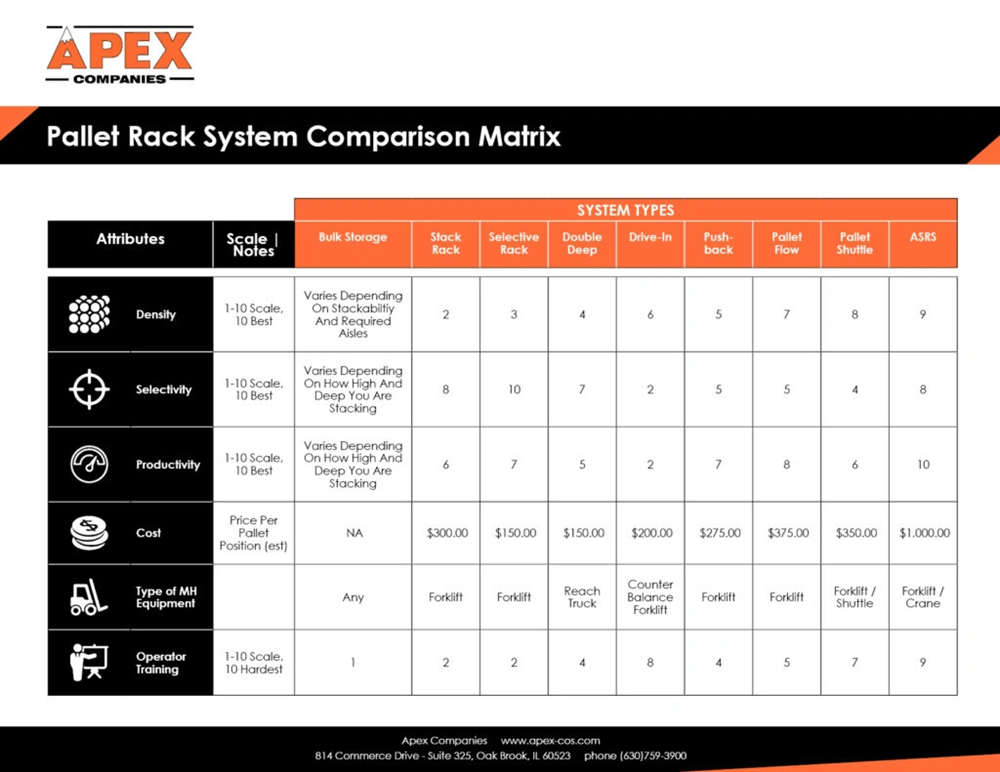
Financial planning requires precise cost analysis for warehouse rack systems. Pricing varies based on racking configuration, complexity, and required components.
Pallet Position Costs by System Type
Warehouse racking system costs reflect storage density and functionality specifications. Selective pallet racking costs USD 50.00 to USD 200.00 per pallet position. This configuration provides direct access but lower storage density.
Double-deep racking costs USD 75.00 to USD 300.00 per pallet position. Drive-in systems cost USD 115.00 to USD 500.00 per pallet position. These systems maximize space utilization through deeper storage lanes.
Push-back racking costs USD 150.00 to USD 450.00 per pallet position. The system provides high density with good selectivity. Pallet flow racking costs USD 200.00 to USD 450.00 per pallet position. FIFO capabilities and high throughput rates justify the premium pricing.
Installation and Component Costs
Installation costs add 15-35% to equipment purchases. Geographic location and system complexity affect pricing. Labor rates range from USD 50.00 to USD 100.00 per hour per worker in North America.
Required accessories include:
- Wire decking: USD 15.00 to USD 21.00 per pallet position
- Cross bars: USD 12.00 to USD 16.00 per pallet position
- Upright protectors: USD 20.00 to USD 30.00 each
- End-of-aisle protectors: USD 105.00 to USD 125.00 each
These components add 10-15% to total project costs. Safety accessories reduce maintenance costs and extend system lifespan. Capacity labels are mandatory in certain jurisdictions to prevent overloading.
Material handling equipment Investment
Forklifts and material handling equipment represent a substantial warehouse investment. Equipment selection affects upfront costs and operational efficiency.
Acquisition costs require evaluation alongside operational expenses. New machines provide improved efficiency and longer service life compared to used equipment. Electric vehicles utilize 87-91% battery power versus 16-25% for gasoline-powered alternatives.
Maintenance expenses accumulate throughout equipment lifecycles. Regular servicing prevents breakdowns and operational disruptions. Operator training reduces accident risk and product damage.
Total ownership costs include purchase price, warehouse management system integration, parts availability, and technological capabilities.
Safety Requirements and Load Capacity Specifications
Safety requirements and load capacity calculations determine warehouse rack system implementation. Proper capacity calculations and regulatory compliance provide essential operational standards.
Load Capacity Calculations for Frames and Beams
Load capacity calculations require frame dimensions and beam configuration analysis. Upright capacity depends on frame height, depth, and column measurements. 144″ upright frames with 3″ x 1-5/8″ columns support 16,700 pounds. 192″ frames with 3″ x 3″ columns handle 25,300 pounds.
Beam capacity relates directly to length and depth specifications. 96″ rack beams with 3.5″ depth support 4,044 pounds per pair. 4.3″ depth increases capacity to 6,111 pounds. Safety factors account for dynamic loading, weight distribution variations, and material fatigue.
Load Limit Display Requirements
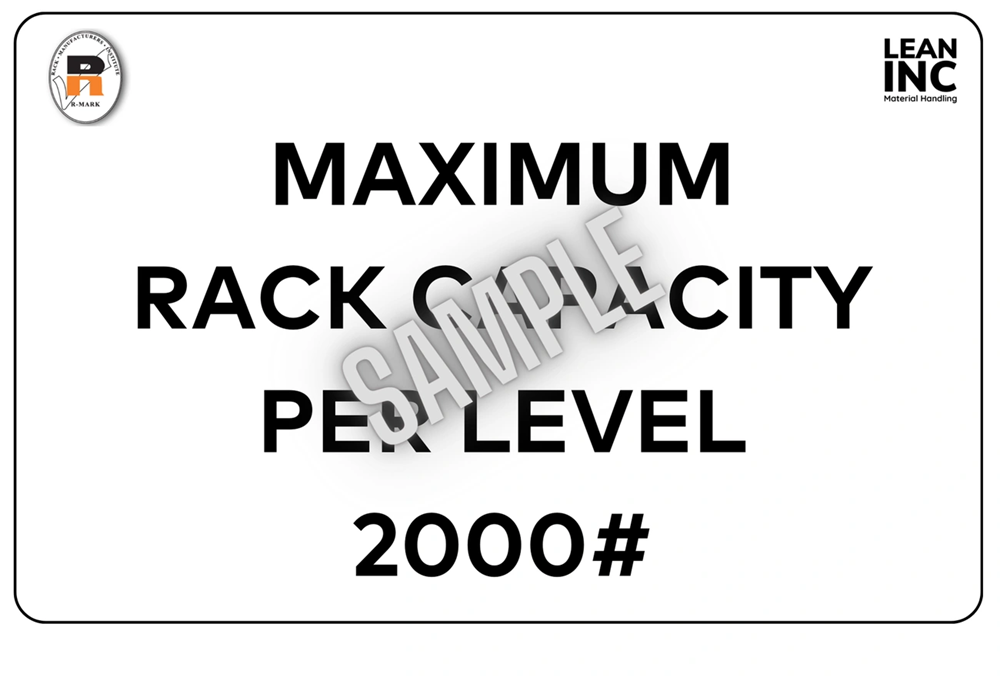
OSHA requires clear, durable load capacity labels on all pallet racks. Load plaques reduce overloading risks and prevent structural failures. ANSI MH16.1-2023 specifications require these label components:
- Maximum permissible unit load per level
- Average unit load if applicable
- Total average load per bay
- Maximum total load per bay
Non-compliance results in fines up to $15,625 per violation. Rack configuration changes require updated load plaques with revised capacity calculations.
OSHA Compliance and Inspection Protocols
OSHA’s National Emphasis Program on Warehousing Operations (CPL 03-00-026) began in October 2023. Regular internal inspections identify potential violations before OSHA audits. Inspection items include beam damage, missing components, column damage, and frame alignment.
Documentation demonstrates compliance during audits. OSHA standard 1910.176(b) requires secure storage preventing falling objects. Column protectors and proper anchoring provide additional compliance measures.
Outsourcing Options: 3PL Services vs In-House Racking
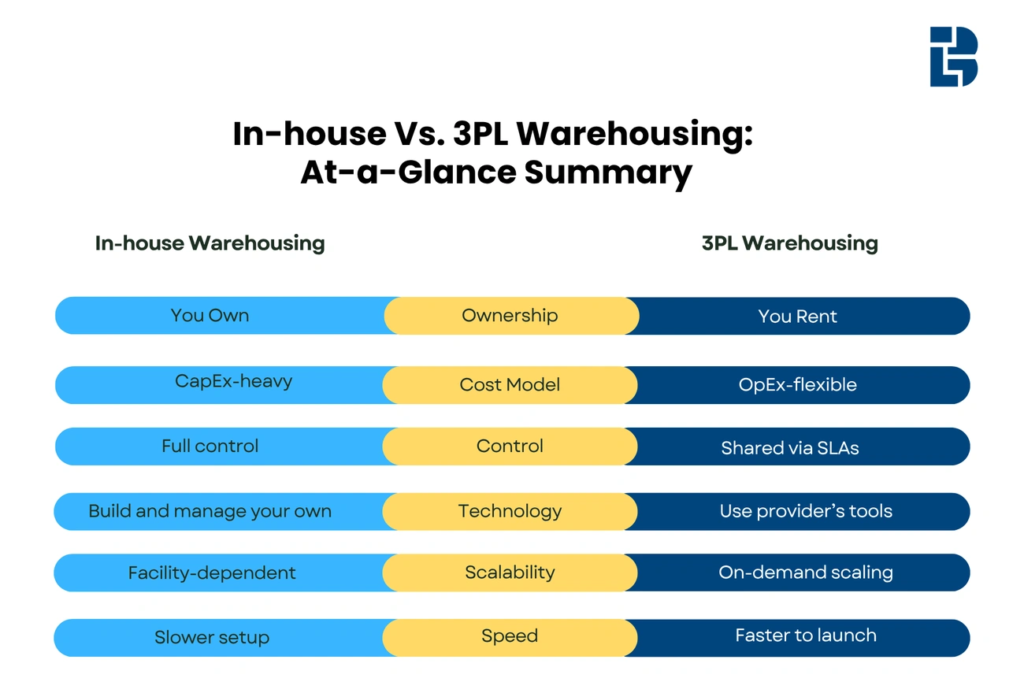
Businesses require warehouse management decisions between in-house racking systems and third-party logistics providers (3PLs). These choices affect operational efficiency and financial results.
Financial Analysis of Outsourcing
In-house warehouse operations require capital investments for infrastructure, equipment, and maintenance. 3PL partnerships convert fixed warehouse expenses to variable costs. Businesses pay for warehouse space actually used. 3PLs distribute fixed costs across multiple clients, achieving economies of scale. Smaller organizations benefit from this model when lacking resources for logistics capabilities.
Business Scenarios for 3PL Efficiency
3PLs provide value for businesses with seasonal demand variations. Peak periods allow capacity increases without long-term commitments. Slower intervals permit scaling down. Organizations focus on core competencies including product development, marketing, and sales rather than logistics operations. Specialized products requiring unique handling find 3PLs more cost-effective than developing internal capabilities.
Technology and Infrastructure through 3PLs
3PLs invest in technology beyond individual company capabilities. Current analysis shows 51.5% of 3PLs access real-time supply chain data compared to 31.5% of shippers. Technology advantages include location visibility, automated order routing, and predictive analytics for stockout prevention.
Summary
Warehouse rack systems provide essential storage infrastructure for business operations. This guide covered rack system types, design specifications, cost factors, safety requirements, and outsourcing considerations. Each system configuration serves specific storage requirements based on product characteristics and operational workflows.
Business selection requires analysis of three factors: accessibility requirements, storage density needs, and budget limitations. Selective pallet racking offers maximum accessibility. Drive-in systems provide higher density storage. Each configuration addresses different operational priorities.
Safety compliance requires proper capacity calculations and load limit documentation. OSHA standards establish minimum requirements for rack labeling and inspection procedures. Regular maintenance prevents equipment failures and ensures workplace safety.
Cost varies from $50 to $500 per pallet position depending on system complexity. Installation adds 15-35% to equipment costs. Material handling equipment represents additional investment requirements. Total project costs reflect system specifications and operational scale.
Business scale and demand patterns determine outsourcing decisions. 3PLs provide technology access and operational flexibility for variable demand operations. In-house systems offer direct operational control for stable demand patterns.
Warehouse racking systems function as operational assets affecting business efficiency. Proper system selection requires analysis of inventory profiles, growth requirements, and workflow specifications. The optimal configuration balances current requirements with future operational flexibility.
Key Takeaways
Understanding warehouse racking systems is crucial for maximizing storage efficiency and operational success in modern logistics operations.
• Choose racking type based on inventory flow: Selective racks offer maximum accessibility for diverse SKUs, while drive-in systems maximize density for uniform products with LIFO requirements.
• Design for your equipment first: Aisle width must accommodate your material handling equipment—standard forklifts need 10.5′-13′ aisles, while VNA equipment allows 5′-7′ aisles for higher density.
• Budget $50-500 per pallet position: Costs vary dramatically by system type—selective racking starts at $50 while pallet flow systems reach $450 per position, plus 15-35% for installation.
• Safety compliance is non-negotiable: Display clear load capacity labels on all racks and maintain 18-24″ ceiling clearance for fire safety—OSHA violations can cost up to $15,625 each.
• Consider 3PLs for flexibility: Outsourcing converts fixed warehouse costs to variable expenses and provides access to advanced technology, especially beneficial for seasonal businesses or smaller operations.
Proper warehouse racking selection requires balancing accessibility, storage density, and budget while prioritizing safety compliance. The right system transforms storage from a cost center into a competitive advantage that scales with business growth.
FAQs
Q1. What are the main types of warehouse racking systems? The main types include selective pallet racking, drive-in/drive-through racking, push-back racking, pallet flow racking, cantilever racking, and carton flow systems. Each type offers different benefits in terms of storage density, accessibility, and inventory management.
Q2. How do I choose the right aisle width for my warehouse? Aisle width depends on your material handling equipment. Wide aisles (10.5′-13′) work for standard forklifts, narrow aisles (8.5′-10.5′) require forklifts with tighter turning radii, and very narrow aisles (5′-7′) need specialized VNA equipment. Consider your equipment specifications and add clearance for safe operation.
Q3. What factors affect the cost of warehouse racking systems? Costs vary based on racking type, storage density, installation complexity, and additional accessories. Prices range from $50 to $500 per pallet position. Installation typically adds 15-35% to equipment costs. Factor in material handling equipment expenses as well when budgeting.
Q4. How can I ensure my warehouse racking system is safe and compliant? Display clear load capacity labels on all racks, maintain proper ceiling clearance for fire safety, and conduct regular inspections for damage. Follow OSHA guidelines and industry standards like ANSI MH16.1-2023. Implement safety accessories such as column protectors and ensure proper anchoring of racks.
Q5. When should a business consider outsourcing to a 3PL instead of managing in-house racking? Consider 3PLs if your business experiences seasonal demand fluctuations, lacks resources for comprehensive logistics capabilities, or wants to focus on core competencies. 3PLs offer flexibility, advanced technology access, and can be more cost-effective for smaller operations or those with specialized product handling needs.