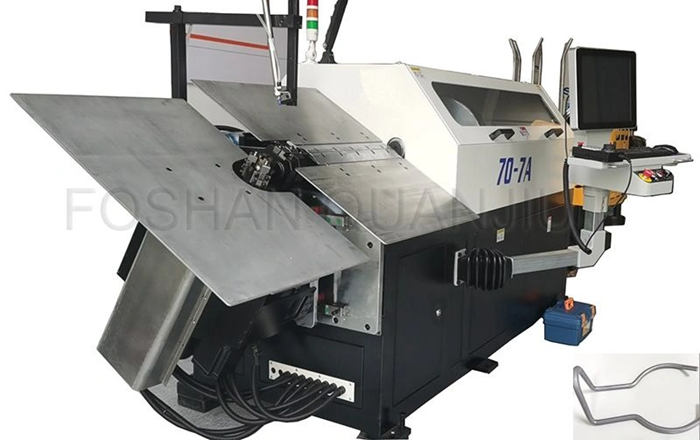
Wire forming creates retail fixtures through bending, cutting, and shaping techniques applied to metal wire. The manufacturing process produces angled, coiled, or bent wire forms for display hook production used in supermarkets and retail stores. Wire diameters typically range from 0.5 mm to 6.5 mm (1/64 inch to 0.25 inch). Manufacturers produce both two-dimensional and three-dimensional structures to meet commercial requirements.
Custom wire forming applies techniques including bending, extrusion, upsetting, and twisting to create shaped metal components. The precision wire forming process produces designs for retail display applications. Wire form manufacturing serves construction, medical, industrial, and retail display fixture industries. Specialized wire forming machinery works with wire diameters from 0.05 inches to 1.25 inches. This provides the capability for customized projects.
The main products and services covered are: techniques, materials, and design considerations for display hook manufacturing in retail environments. Business model focuses on B2B applications where consistency and quality standards determine product performance.
Understanding Display Hook Wire Forming
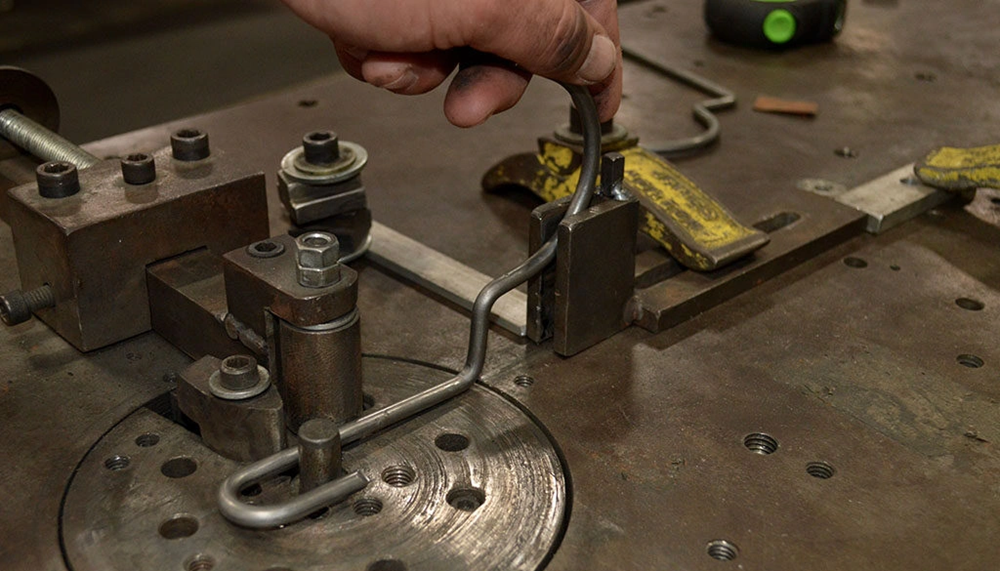
Display hook wire forming produces retail fixtures through precision engineering and manufacturing processes. The process creates hooks for merchandise display in retail environments.
Definition of Wire Forming in Retail Fixtures
Wire forming takes metal wire from spooled coils or cut lengths and shapes it through bending, coiling, cutting, or other techniques. Retail applications use this process for product presentation systems. Wire forming produces simple hooks to elaborate shelving units.
Display hooks represent common wire-formed products in retail settings. These components hold merchandise in high-traffic store areas. Customers access and inspect products easily. Retail wire displays function as point-of-purchase fixtures positioned near cash registers or throughout store aisles.
Manufacturing process for display hooks includes:
- Wire selection based on intended load capacity
- Precision straightening of wire material
- Specialized bending techniques application
- Surface finishing (powder coating, plating, or painting)
- Quality control inspection
Display hooks support products, enhance visibility, and contribute to shopping experience. Wire-formed components include peg-board hooks, slat-wall hooks, loop hooks (with or without scanner tag hooks), and custom designs for specific retail environments.
Why Display Hooks Require Specialized Forming
Display hooks require specialized forming techniques for retail applications. Components must be lightweight for repositioning while supporting merchandise without deformation.
Wire diameters typically range from 0.125 to 0.187 inches in display hook manufacturing. Custom specifications are common based on applications. Material selection determines hook performance. Options include galvanized wire for standard applications and stainless steel for enhanced durability or corrosion resistance.
Wire forming for display hooks requires precision for several factors:
- Load-bearing considerations: Hooks support specific product weights without bending or breaking
- Consistent sizing: Uniformity is required for thousands of identical hooks in nationwide store implementations
- Safety requirements: Finished hooks must be free from burrs and sharp edges
- Professional appearance: Visible retail components maintain brand image alignment
Manufacturers use specialized wire forming machinery, including CNC and fourslide forming machines, for retail display hook production. Advanced systems create consistent bends, curves, and profiles based on precise drawings and renderings.
Retail display hooks require additional finishing processes to enhance appearance, durability, and resistance to scratching and corrosion.
Display hooks are manufactured in large quantities to achieve economies of scale. Minimum order quantities often start at 10,000 units. A mass-production approach combined with precise specifications requires specialized forming techniques.
Wire Forming Manufacturing Techniques for Display Hook Production
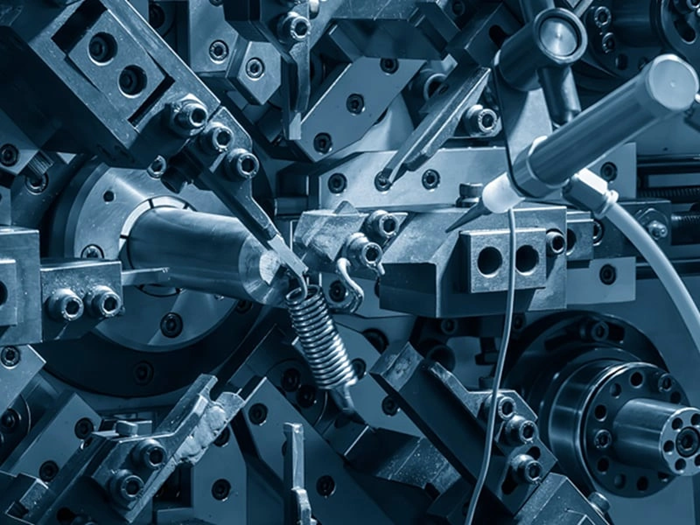
Display hook manufacturing employs specialized techniques based on production volume, design complexity, and cost requirements. Three primary methodologies serve as industry standards for retail display applications.
CNC Wire Bending for Complex Hook Geometries
Computer Numerically Controlled wire-bending systems provide precision manufacturing for three-dimensional display hook profiles. These machines operate in pneumatic, hydraulic, and electric servo-driven configurations.
CNC wire bending systems offer:
- Wire cutting to exact dimensions
- Bending angles up to 180 degrees with an accuracy of ±0.05°
- Rotation angle precision of ±0.05°
- Wire diameter processing from 0.008 to 0.250 inches (0.0203 to 6.35 mm)
CNC wire forming suits prototyping and low-volume production, where complex geometries require precise tooling. Material processing capabilities include music wire, hard-drawn wire, stainless steel (300 series), brass, and beryllium copper.
Single-headed wire benders produce 3D shapes with wire diameters up to 10 mm. Double-headed machines handle symmetrical parts with diameters up to 12 mm.
Fourslide Forming for High-Volume Manufacturing
Fourslide forming technology produces nearly 15,000 pieces per hour, depending on part complexity. Fourslide machines operate horizontally using four tool-carrying slides approaching the workpiece from four directions.
System operation includes:
- Four shafts connected by bevel gears, driven bya single electric motor
- Cams are attached to each shaft, controlling slide movement
- Multidirectional forming that bends or stampsthe workpiece from all four sides
Fourslide stamping integrates multiple operations—bending, punching, and cutting—into single machine cycle. The process begins with flat metal strip from coil, stamped in progressive die section before entering forming area.
Business advantages include:
- Tooling costs from $3,000 to $10,000, compared to progressive dies costing 10 times more
- Material efficiency with reduced scrap
- Design flexibility allowing engineering changes with simple tool adjustments
Manual vs. Automated Manufacturing Methods
Manual wire forming uses hand-operated machines with levers and spindles, incorporating gears that amplify bending force. These systems serve extremely small production runs or unique custom hooks.
Automated wire forming machines handle complete production without direct human intervention.
| Manufacturing Aspect | Manual Methods | Automated Systems |
|---|---|---|
| Production Speed | Limited capacity | Up to 70m/min feeding speed [11] |
| Quality Consistency | Operator-dependent | Repeatable results |
| Complex Geometries | Difficult execution | Intricate 3D forms |
| Setup Requirements | Faster for single pieces | Initial programming required |
| Investment Cost | Lower initial cost | Higher upfront, lower per-unit cost |
Automated 3D wire bending machines feature Japanese Sanyo Denki servo motors, touch screen displays, and Taiwanese controllers [11]. Bending speeds reach 180° in 0.5 seconds with rotation speeds of 360° in 2 seconds.
No middle men in automated systems can offer reasonable price with high level quality. Have more than 12 years industry experience in automated wire forming applications.
Material Selection for Display Hooks
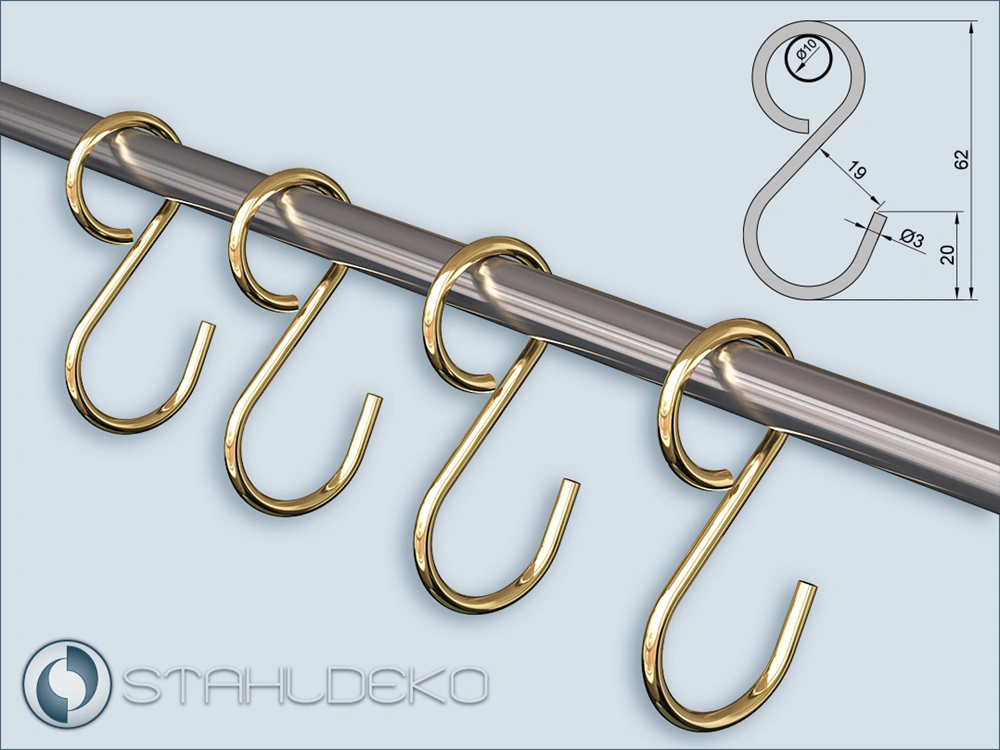
Material selection determines the performance, longevity, and appearance of retail display hooks. Each metal provides specific properties for different retail environments and product display requirements.
Stainless Steel 304 vs 316 for Corrosion Resistance
Stainless steel serves as the standard material for display hooks in high-traffic retail environments. The two common grades—304 and 316—have different chemical composition and corrosion resistance properties.
304 stainless steel contains 18-20% chromium and 8-10.5% nickel. This provides resistance to mild acids and alkaline solutions. The composition works for standard retail environments with normal humidity levels. 304 offers cost-effective solution for indoor displays and general merchandise presentation.
316 stainless steel contains 16-18% chromium, 10-14% nickel, and 2-3% molybdenum. Molybdenum addition increases resistance to pitting and crevice corrosion in environments with salt, acids, and aggressive cleaning agents. 316 stainless steel display hooks perform well in:
- Coastal retail locations with salt-laden air
- Grocery store refrigerated sections
- Outdoor garden centers with high humidity
- Stores requiring frequent chemical cleaning
316 provides superior corrosion resistance but costs more than 304. Wire form manufacturing companies recommend 304 for standard indoor retail applications. 316 is used when enhanced durability justifies higher investment.
Aluminum for Lightweight Applications
Aluminum hooks provide lightweight properties with substantial strength for portable merchandising solutions and temporary displays. Reduced weight allows easier installation and reconfiguration for seasonal displays or frequently changed retail layouts.
Wire thickness determines aluminum hook applications:
- Soft aluminum wire (0.3-0.8 mm): Flexible with minimal structural strength, suitable for lightweight accessory displays
- Medium-soft aluminum wire (1-2 mm): Balanced flexibility and durability for standard merchandise hooks
- Hard aluminum wire (3-5+ mm): Structural support for heavier products
Precision wire forming machinery processes aluminum efficiently. Clean bends are created without material fracturing. Aluminum hooks can be anodized in various colors. This allows retailers to match display components with brand requirements without powder coating.
Brass and Copper for Premium Finishes
Retail environments requiring premium appearance use brass and copper display hooks. Solid brass construction provides strength that prevents hooks from snapping or bending under weight.
Brass hooks have “living finish” that develops patina over time. This creates appearance for upscale retail environments. The natural aging process adds character to display fixtures while maintaining structural integrity.
Copper wire forms provide visual appeal for specialty retail settings. Copper has electrical and thermal properties for specialized display applications. Both brass and copper offer antimicrobial properties.
Custom wire forming techniques for brass and copper account for greater malleability compared to stainless steel. Manufacturers use thicker wire diameters or reinforced designs when creating display hooks from these softer metals.
Precision Wire Forming Machinery in Hook Manufacturing
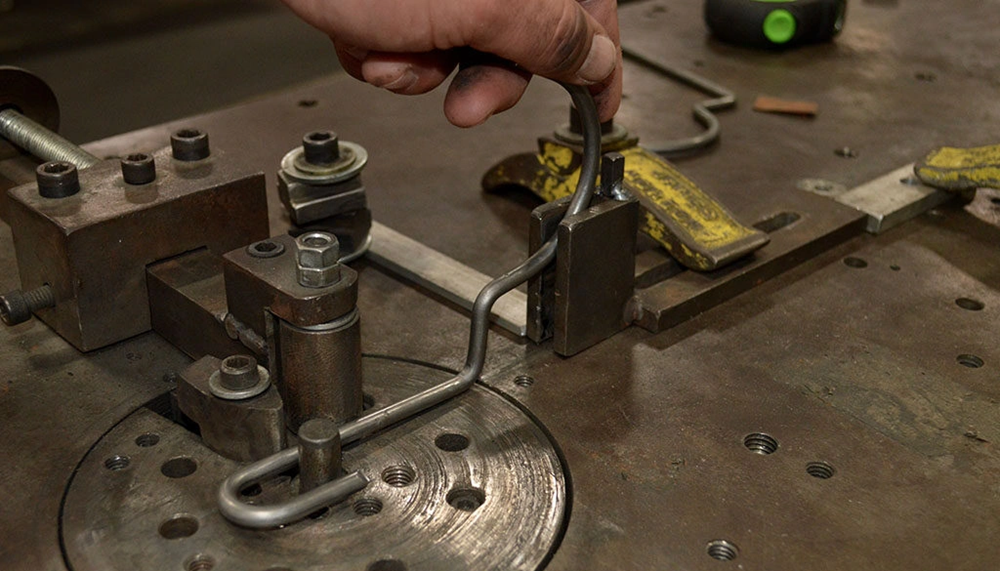
We have specialized machinery for display hook manufacturing. Advanced equipment delivers the precision and consistency required for retail fixtures. Each machine type offers capabilities that address production challenges in the wire forming industry.
Ultimat UMW-100 for Integrated Bending and Welding
The Ultimat UMW-100 processes wire ranging from 3.00 mm to 10.00 mm in diameter. This system handles standard retail display hooks. The machine’s integrated medium-frequency direct current (MFDC) welding technology transforms incoming 50/60 Hz power to 1,000 Hz, producing precise weld pulses with minimal spatter.
Equipment specifications include:
- Reduced power consumption compared to traditional welding equipment
- Wire processing directly from coil
- Maximum frame size capability of 1200 x 1200mm
- Closed die forming and cutting system producing square, burr-free cuts
The 2-axis, PC-controlled machine uses Windows-based software. The UMW-100 delivers repeatability of ±0.05° on bends and ±0.1mm on feed length. This ensures consistency across production runs.
CNC Servo-Driven Machines for Tight Tolerances
CNC servo-driven machines provide exceptional precision capabilities for display hook manufacturing. These systems utilize high-resolution encoders and closed-loop feedback mechanisms. Positioning accuracy surpasses traditional mechanical bending methods.
Modern CNC wire bending equipment features:
- Tolerances as tight as .010 inches
- Capabilities for chamfering, producing spherical or pointed parts
- Multi-axis control (up to 7 axes) for complex hook geometries
- Processing capabilities for wire diameters from .091 to 5/16 inches
Control systems monitor position, velocity, and torque parameters continuously. Real-time adjustments maintain consistent quality throughout production [18]. Technology eliminates backlash and wear issues common in gear-driven systems.
Wire Straightening and Cutting Systems
Wire straightening and cutting systems prepare raw material for precision forming. These servo-driven machines achieve high-speed production while maintaining quality standards.
Modern wire straightening equipment specifications:
- Cutting length tolerance of +/- 0.5 mm
- Touch screen control systems with preset output capabilities
- No-damage processing that preserves wire surface integrity
- Flying shear structures for enhanced precision
These systems increase efficiency three to four times faster than traditional straightening and cutting machines. The straightening process uses wire feeding wheels and straightening shafts.
Have more than 12 years of industry experience with specialized machines. The combination of Ultimat welding systems, CNC servo-driven benders, and high-precision straightening equipment creates production flow from raw material to finished product. No middle men, can offer reasonable price of high level quality manufacturing.
Design Specifications for Custom Display Hooks
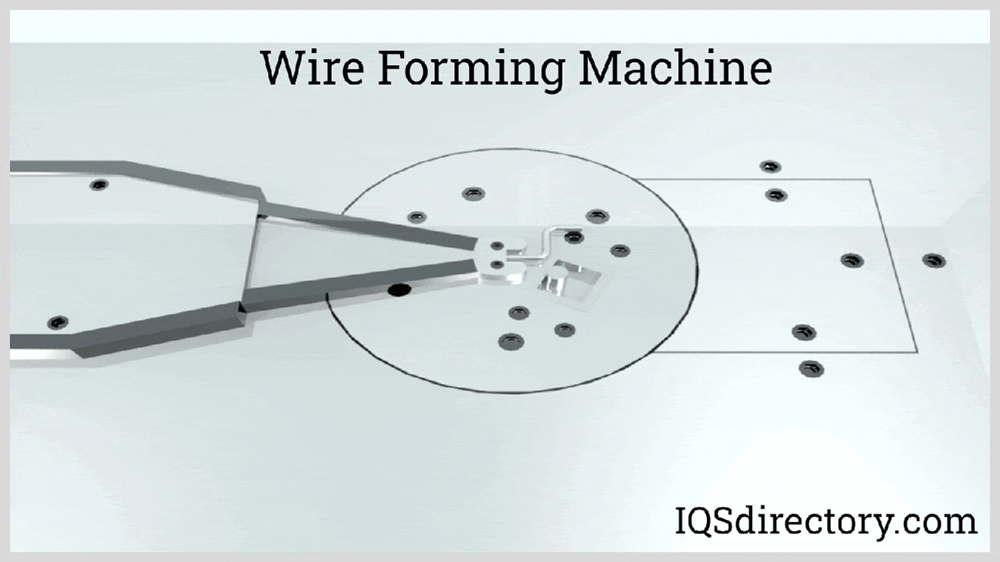
Custom display hooks require three engineering factors that determine performance and appearance. The mechanical principles behind these fixtures enable manufacturers to optimize designs for retail environments.
Load-Bearing Capacity and Hook Geometry
Load capacity of display hooks depends on geometric configuration. The relationship follows: Mmax ≈ σs x ø³/99.5e, where Mmax represents maximum load before permanent deformation, σs equals bending strength (approximately 0.8 x tensile strength), and e signifies orthogonal distance. Standard metal hooks support 10-20 pounds when installed in drywall, reach 30-50 pounds when anchored to structural members.
Hook shape influences behavior under stress. R-hooks have minimal safety margins above yield point. DV-shaped hooks demonstrate substantially higher safety thresholds. DV/DVM configurations provide safer choices for retail environments where hooks bear unexpected loads.
Wire Diameter Selection Based on Product Weight
Wire diameter selection represents a fundamental decision in custom hook design. Wire thickness correlates directly with weight-bearing capacity. Careful matching between product specifications and hook dimensions is required.
Key considerations include:
- Product type and individual weight measurements
- Total anticipated load with multiple items
- Material properties of selected wire
- Safety factor required for application
Wire displays utilize different gages depending on application requirements. Hooks for heavier merchandise require consideration of both wire material and thickness to prevent deformation under sustained weight. Reinforced slatwall with aluminum inserts can achieve 50-pound capacity per bracket. This improves over standard configurations supporting only 12 pounds.
Surface Finishing: Powder Coating vs. Plastisol
The choice between powder coating and plastisol affects both performance and esthetics of display hooks. Powder coating involves electrostatic application of dry paint followed by heat curing, creating protective layers without volatile organic compounds. Plastisol requires dipping parts into liquid PVC solution before heating to solidify the coating.
Powder coating provides superior durability with resistance to chipping, scratching, fading, and corrosion. This makes it suitable for high-traffic retail environments. The finish appears even and offers various textures from matte to glossy.
Plastisol delivers thicker cushioned coatings with variable thicknesses that protect delicate merchandise. This process creates a more forgiving surface but may lack the sleek uniformity of powder-coated hooks. Plastisol coatings are suitable for specialized applications requiring sound reduction, thermal insulation, or enhanced grip characteristics.
Manufacturing Challenges for Display Hook Production
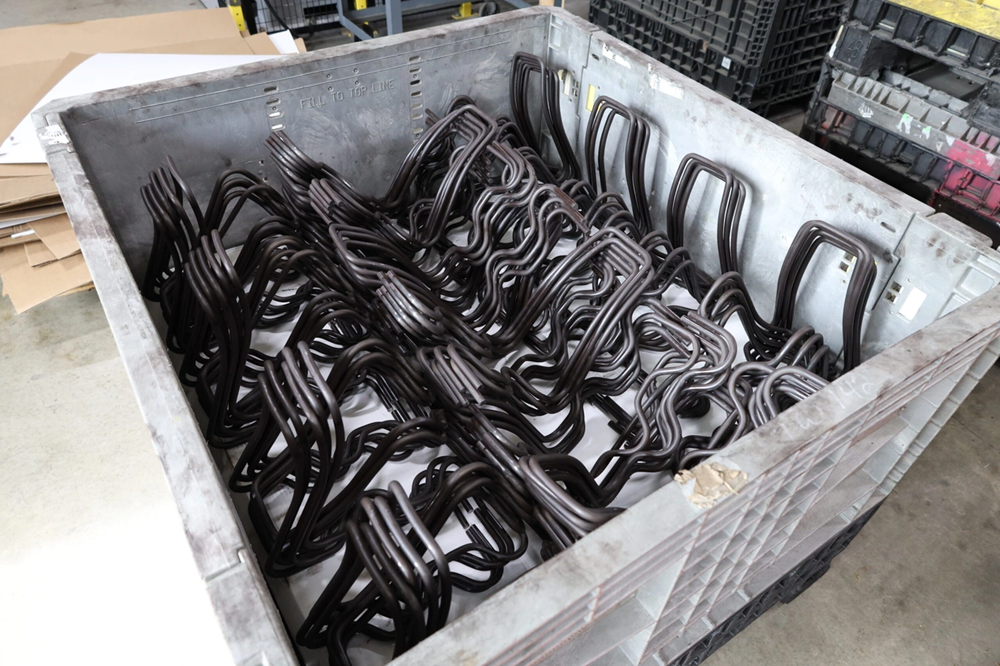
Display hook manufacturing presents technical challenges that require specialized equipment and quality control procedures. We have more than 12 years of industry experience addressing these production issues.
Compound Bend Formation Issues
Complex wire hooks with multiple bends create deformation problems during production. Bending wires along edges can blunt critical surfaces, particularly problematic for hooks requiring sharp internal angles [25]. We bend wires from the outside rather than inside, using specialized press brakes that complete bends without compromising edge integrity.
Springback occurs when formed metal relaxes and fails to maintain its intended shape. Material portions do not fully reach plastic deformation during forming. We compensate through intentional overbending, where features are formed beyond target dimensions.
Quality Control in High-Volume Production
Minor deviations in manufacturing processes create substantial quality issues at production scale. High-volume manufacturing creates difficulties monitoring and controlling quality across entire production runs. Wire diameter irregularity results from small grooves in forming curve gage or incorrect installation position.
We conduct regular quality checks throughout production to identify inconsistencies before they affect large batches. Our factory delivers hooks with consistent precision and quality regardless of volume, from small prototype runs to orders exceeding 100,000 pieces.
Burr Removal and Edge Finishing
Burrs create sharp, jagged tears or accumulated slag on cut edges, posing safety risks and functionality problems. These protrusions act as stress concentrations and locations for corrosion or particulate buildup. Different manufacturing processes create distinct burr types: laser cutting produces oxidation slag on bottom edges, while CNC routing causes breakout or tear burrs on both top and bottom edges.
Finishing operations remove burrs to ensure safety and functionality. Methods range from manual deburring using files and brushes to automated processes with specialized machinery. We use automated deburring for high-volume display hook production, providing consistent results without time-consuming manual techniques.
Business Summary
Wire forming techniques provide the foundation for display hook manufacturing operations. The processes covered include CNC wire bending, fourslide forming, and automated production methods that determine product quality and functionality. Material specifications between stainless steel 304, stainless steel 316, aluminum, brass, and copper affect both performance characteristics and visual presentation requirements.
Display hook production requires attention to load-bearing capacity calculations, wire diameter specifications, and surface finishing options. These factors create products that support merchandise loads while meeting retail presentation standards. Each hook design balances engineering requirements with commercial applications.
Manufacturing challenges include compound bend formation, consistency maintenance across high-volume production runs, and burr elimination from finished products. Display hook production requires specialized equipment and technical knowledge. Quality manufacturers maintain consistent standards across all production volumes, ensuring product performance in retail environments.
Display hooks function as essential components in retail merchandising systems. These wire-formed products support retail displays in supermarkets and stores worldwide. High-quality display hook manufacturing provides enhanced product presentation, customer accessibility, and visual merchandising efficiency.
We have our own factory and have more than 12 years of industry experience in wire forming and display hook manufacturing. No middle men, can offer a reasonable price of a high level quality. Have ISO9001:2015 Certification for quality assurance in all metal fixture production including gondola, shelving, display hook and display rack applications.
Key Takeaways
Master these essential wire forming principles to achieve superior display hook manufacturing that combines precision engineering with retail functionality.
• Choose the right forming technique for your volume: CNC bending excels for complex 3D profiles and prototypes, while fourslide forming delivers up to 15,000 pieces per hour for high-volume production runs.
• Material selection directly impacts performance: Stainless steel 304 suits standard indoor retail, 316 handles harsh environments, aluminum provides lightweight portability, and brass/copper offer premium esthetics.
• Wire diameter must match load requirements: Proper sizing prevents deformation under weight—standard hooks support 10-20 pounds in drywall but reach 30-50 pounds when anchored to structural members.
• Precision machinery ensures consistent quality: Modern CNC servo-driven systems achieve tolerances as tight as ±0.010 inches, while integrated bending-welding machines like the Ultimat UMW-100 streamline production.
• Surface finishing affects durability and appearance: Powder coating provides superior chip and corrosion resistance for high-traffic areas, while plastisol offers cushioned protection for delicate merchandise.
The key to successful display hook manufacturing lies in understanding that these seemingly simple fixtures require sophisticated engineering. Every bend angle, material choice, and finishing decision impacts both structural integrity and retail performance, making precision wire forming an essential skill for creating reliable merchandising solutions.
FAQs
Q1. What are the main techniques used in manufacturing display hooks? The main techniques for manufacturing display hooks include CNC wire bending for complex 3D profiles, fourslide forming for high-volume production, and manual forming for custom or low-volume orders. CNC and automated systems offer greater precision and consistency for large-scale retail implementations.
Q2. How do you choose the right material for display hooks? Material selection depends on the intended use and environment. Stainless steel 304 is suitable for standard indoor retail, while 316 is better for harsh or humid conditions. Aluminum is ideal for lightweight, portable displays. Brass and copper offer premium esthetics for upscale retail environments.
Q3. What factors determine the load-bearing capacity of a display hook? The load-bearing capacity of a display hook is determined by its geometric configuration, wire diameter, and material properties. The hook’s shape, especially whether it’s an R-hook or DV-shaped, significantly influences its ability to bear weight safely. Proper anchoring also plays a crucial role in maximizing load capacity.
Q4. What are the advantages of powder coating for display hooks? Powder coating provides superior durability with excellent resistance to chipping, scratching, fading, and corrosion. It creates an even finish with various texture options, from matte to glossy, enhancing product presentation. Powder coating is particularly suitable for high-traffic retail environments due to its protective properties.
Q5. How do manufacturers ensure consistency in high-volume production runs? Manufacturers maintain consistency in high-volume runs through regular quality checks, use of precision CNC machinery, and careful monitoring of production parameters. They may employ automated deburring processes and compensate for issues like springback through techniques such as intentional overbending. Specialized equipment like servo-driven machines helps maintain tight tolerances throughout production.