
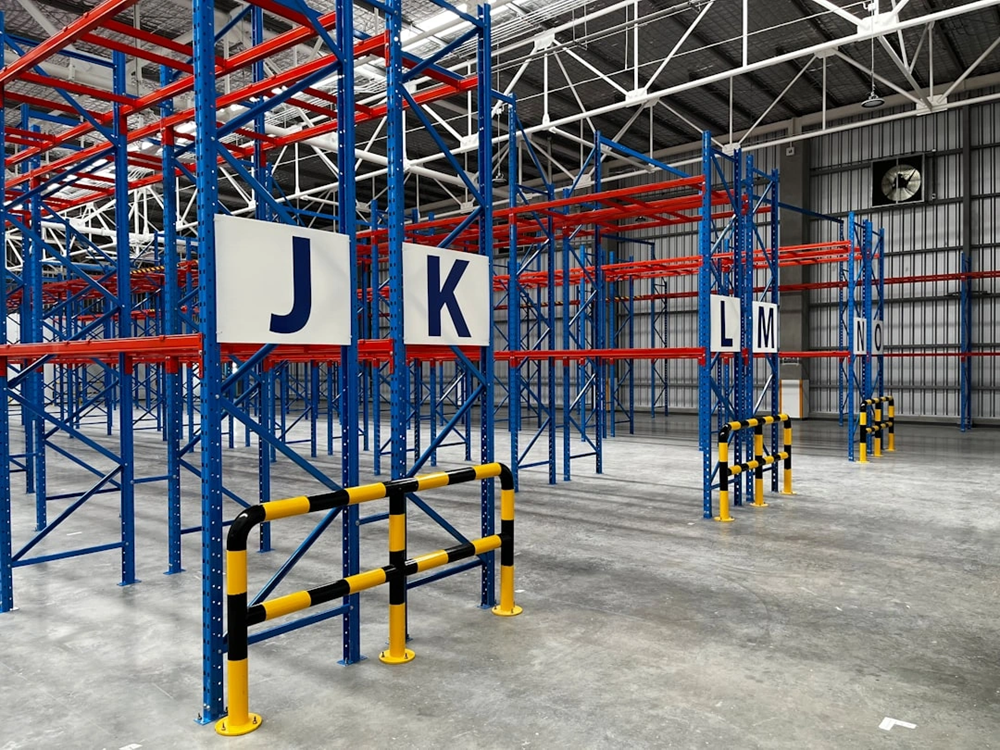
The right pallet rack dimensions will maximize warehouse storage efficiency and safety. Standard rack depths range from 42 to 48 inches (107 to 122 cm). These measurements fit industry-standard pallets of 40×48 inches (102×122 cm) perfectly. This precise sizing helps utilize space optimally while keeping required clearances.
Warehouse racking systems come in different sizes based on operational needs. Beam lengths stretch from 96 to 144 inches (244 to 366 cm), which lets multiple pallets sit side by side. Height options start from 8 feet (244 cm) in smaller facilities and reach up to 30 feet (914 cm) in high-capacity warehouses. The 42-inch uprights are most common, though other standard sizes like 24″, 30″, 36″, and 48″ are accessible to more people who have specific storage needs.
Warehouse rack dimensions are the foundations of efficient inventory management. Each configuration, from selective pallet racking to specialized systems, fits specific warehouse layouts and workflows. The industry standard pallet size (40″ × 48″) works as a universal fit for most systems. Warehouse managers should consider both pallet weight and dimensions while designing their storage solutions. This detailed guide explores standard pallet rack dimensions, configuration options, and key factors that help optimize warehouse storage space.
Standard Pallet Rack Dimensions by Component
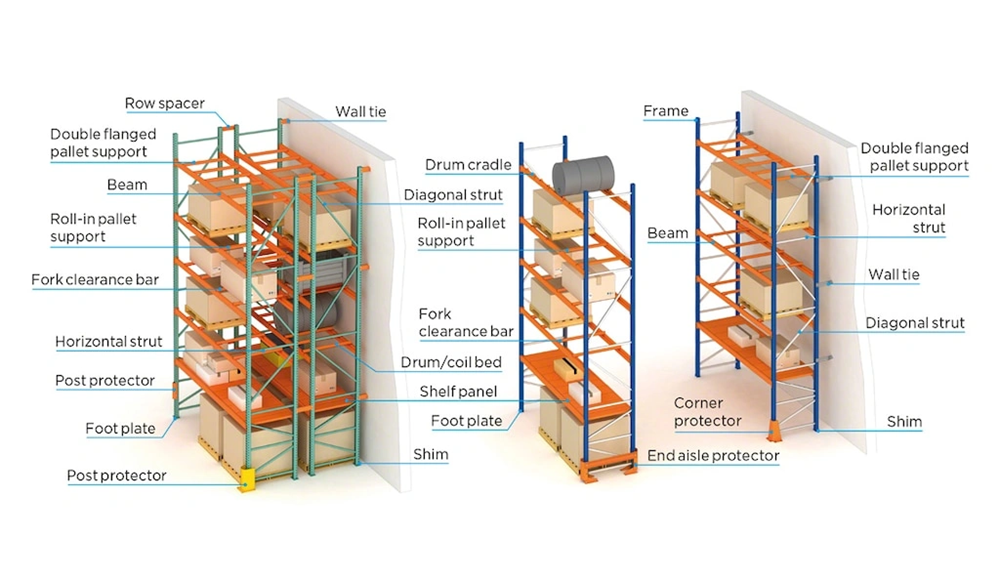
Pallet racking systems have two main parts – upright frames and beams. These come in standard sizes to fit different storage needs. The right dimensions will give you the best warehouse design and rack selection that matches your inventory needs.
Common Upright Frame Heights: 8′ to 30′
Upright frames work as vertical supports in pallet racking systems, with heights ranging from 8 feet to 30 feet. Most warehouses use 12-foot or 16-foot frames as their go-to choice. Standard configurations can reach 20 feet, though custom designs go even higher when needed. Your choice of height depends on your ceiling limits, sprinkler spots, and how high your forklifts can reach. The best way to find the right upright height is simple. Just measure from floor to ceiling (or sprinkler heads), take away 18 inches for clearance plus your pallet and load height. This tells you how high you can place your top beam level.
Beam Lengths for 2-3 Pallet Configurations
Beam lengths match the number of pallets you’ll store on each level. The most common setup uses 96-inch (8-foot) beams to store two standard 40″×48″ pallets side-by-side. This length fits the total 80 inches of pallet width plus needed gaps – usually 5 inches between upright and pallet and 6 inches between pallets next to each other. Three-pallet setups need 144-inch (12-foot) beams, which fit three 40-inch wide pallets with proper spacing. You’ll also find beams in 48″, 60″, 108″, 120″, and 168″ sizes. It’s worth noting that shorter beams can hold more weight, making 8-foot beams better for heavy items even though they hold fewer pallets.
Standard Rack Depths: 36″ to 48″
Your pallet depth determines your rack depth choice. A simple rule is to subtract 6 inches from your pallet depth to get the right upright depth. Standard 48″×40″ GMA pallets work best with 42-inch frames, letting the pallet hang over 3 inches at the front and back. Pallets that are 42 inches deep need 36-inch frames for the best support. While 42-inch frames are most popular, you’ll also see plenty of 36-inch and 48-inch depths. Some warehouses pick full 48-inch depth frames to match pallet sizes exactly, which gets rid of any overhang. This costs more because it needs more steel, but it makes it easier to maintain flue space and keeps aisles neater.
Clearance Guidelines: 3″ Between Pallets
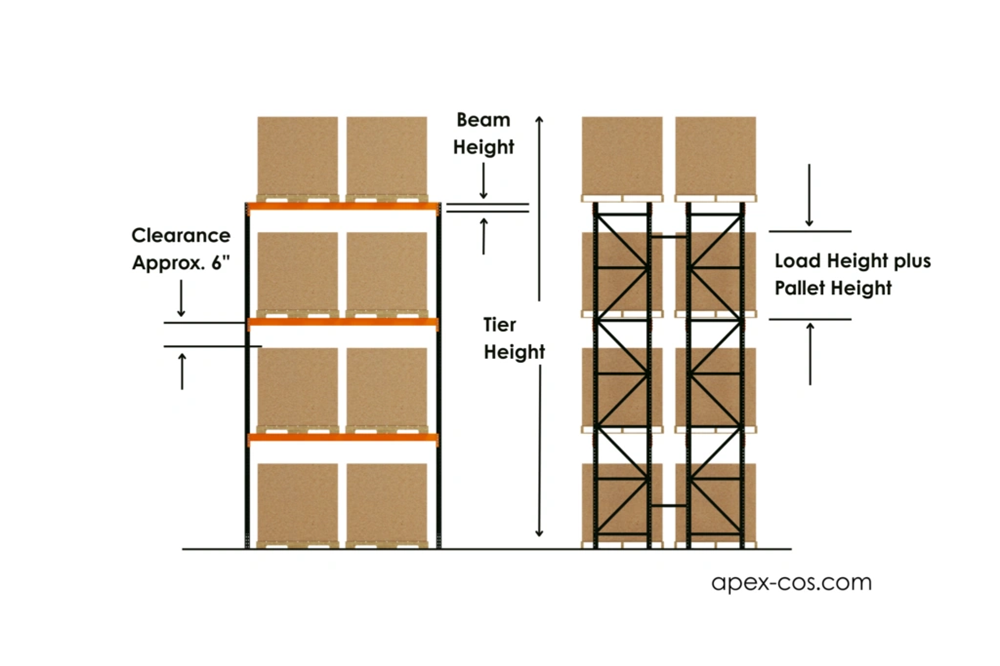
Good clearance stops damage during loading and unloading. You need at least 6 inches between pallets sitting next to each other on the same level. Each pallet should have at least 3 inches (better yet, 4 inches) of space from the upright frames at its widest point. Looking up, keep 4 inches between a load’s top and the beam above it for lower levels, and 6 inches for higher ones. The space between your highest load and lowest hanging obstacle must be at least 10 inches. Back-to-back racks need 6 inches of flue space between rows, which means 12 inches total between racks.
Weight Capacity Considerations by Beam Face
The beam face’s height directly affects load capacity. Beams usually come in heights from 3 to 6 inches, and bigger profiles hold heavier loads. To name just one example, see how 4-inch beams work well for light to medium loads while 6-inch or higher beams handle heavy pallets better. Load ratings go from 2,385 pounds to 9,920 pounds per pair with even weight distribution. A beam’s capacity depends on:
- Beam length: Shorter beams hold more weight
- Steel quality: Better steel means higher capacity
- Connection type: Strong connectors add stability
- Beam design: Box or step designs each have their structural benefits
Most 8-foot beams with 4-inch faces can hold about 5,000 pounds per shelf level, which works out to two 2,500-pound pallets.
Pallet Racking Dimensions by Rack Type
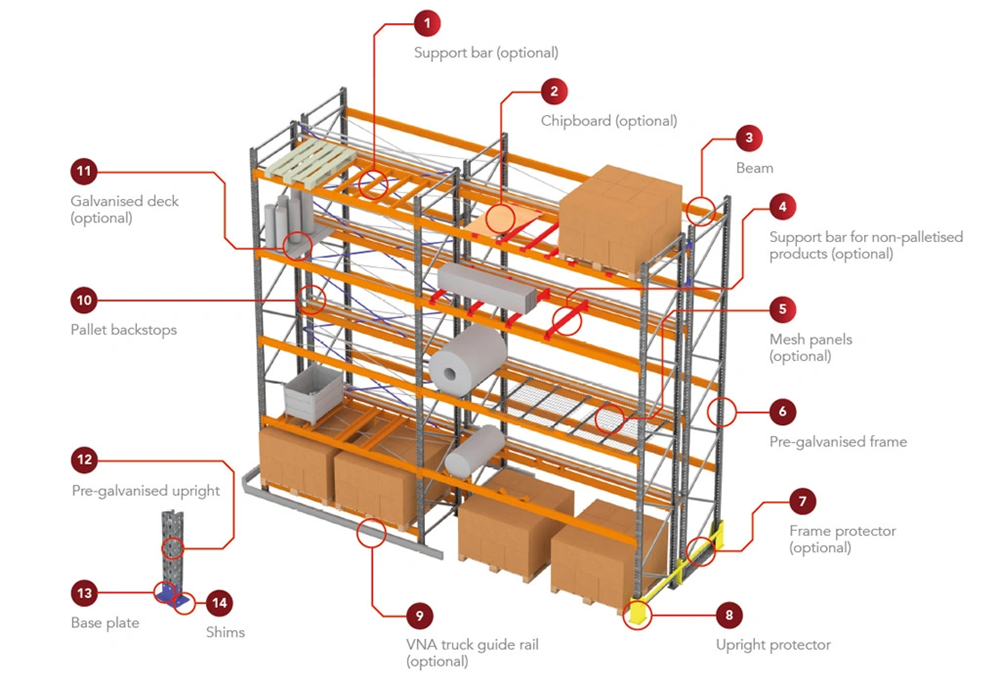
Different rack styles come with unique dimensional setups that match storage needs and inventory management strategies. Each system has specific measurements that help make the best use of space and operations.
Selective Racking: 42″ Depth, 96″–144″ Beams
Selective pallet racking has been the go-to warehouse storage solution since the 1950s because it lets you access every pallet position directly. A standard bay is 96″ wide by 42″ deep and fits two standard pallets side-by-side. The 144″ beams support three-pallet configurations. This system needs a single-deep design with access aisles to reach every pallet, which means lower storage density compared to other setups. You’ll find the typical upright depth by subtracting 6″ from pallet depth – that’s why 48″ pallets need 42″ frames.
Drive-In/Drive-Through: 48″–60″ Depth per Pallet
Drive-in and drive-through racking creates dense storage space that allows forklifts to enter the rack structure directly. These systems store pallets several positions deep, limited only by how well forklifts can move inside. Drive-in racks work with one entry/exit point using the LIFO (Last-In, First-Out) inventory method. Drive-through racks let you load from one side and retrieve from the other for FIFO (First-In, First-Out) operations. Standard depths range from 48″–60″ per pallet position. The overall system depth equals pallet depth plus 2″ multiplied by the number of pallets deep, plus 4″ for movement space.
Push-Back Racking: 2–6 Pallets Deep
Push-back racking works with nested carts on sloped rails where new pallets push existing ones deeper into the system. This dense storage option keeps SKU selectivity while saving space. Most systems store 3-4 pallets deep, though you can find configurations for 2-6 pallets deep per lane. Each top cart has a center stop to keep pallets from falling off the back. The rack depth formula is: (number of pallets deep × (pallet depth + 2″)) + 2″.
Pallet Flow Racking: 2–20 Pallets Deep
Pallet flow racking uses slightly sloped roller beds that let pallets slide from loading to unloading points naturally. This FIFO system helps warehouses store up to 90% more than selective racking. These racks can handle anywhere from 2 to 20 pallets deep, making them perfect for warehouses that need tight stock control and space savings. You’ll find three main roller types: metal skate wheel systems, plastic wheel systems, and wide metal roller systems.
Cantilever and Mobile Racks: Custom Dimensions
Cantilever racking features arms that extend from vertical columns to hold long or oddly shaped items. These systems can be customized with arm depths between 50-150 centimeters and heights from two to six meters. Mobile pallet racking puts standard racks on movable bases that run on floor rails. This setup removes fixed aisles and maximizes storage space. Both systems offer custom solutions that work within your facility size and material handling equipment limits.
How to Measure and Configure Rack Sizes
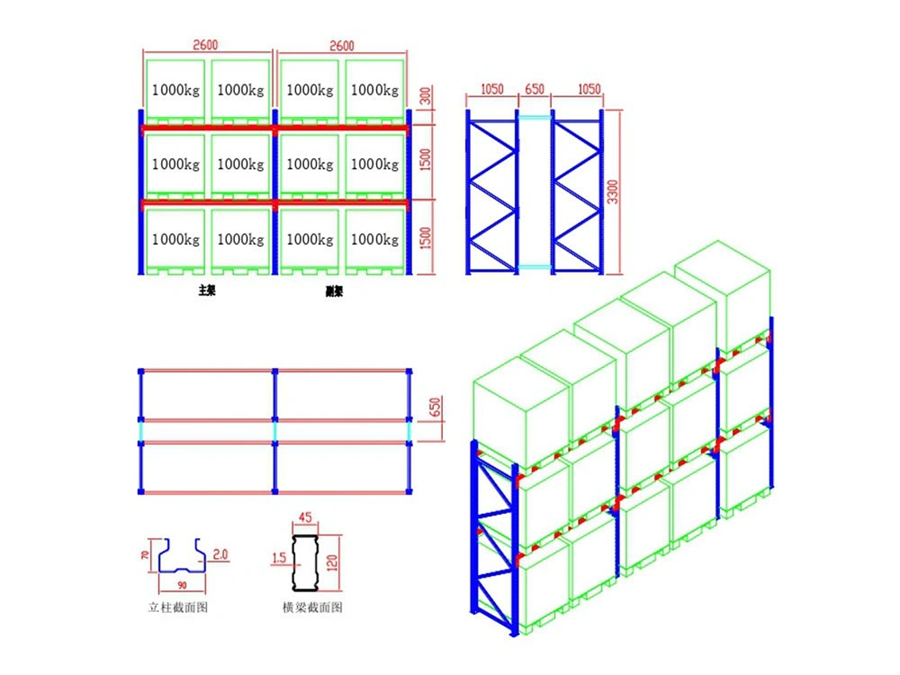
Warehouse managers need precise measurements to configure pallet racks that are both safe and efficient. These five steps will give you the right way to determine rack dimensions that match your needs.
Step 1: Measure Pallet Width, Depth, and Height
The right pallet measurements are the foundations of proper rack setup. Start by measuring the pallet’s width and depth at their widest points. This includes any load that hangs over the edge. Next, measure both the pallet height and the maximum height when loaded. Note that loads might extend beyond the pallet edges, so always use the maximum width measurements instead of just the pallet size. These detailed measurements will give a proper clearance throughout your system.
Step 2: Calculate Frame Depth (Pallet Depth – 6″)
The frame depth calculation needs you to subtract 6 inches from your pallet depth. This allows 3 inches of overhang at the front and back of the rack. A standard 48-inch deep pallet needs a 42-inch rack depth. Some warehouses choose frames that match the exact pallet depth of 48 inches. This eliminates overhang completely but costs more while improving stability.
Step 3: Determine Beam Length Based on Pallet Count
Beam length uses a simple formula: multiply the number of pallets by pallet width, add 6 inches between pallets, and add twice the 3-5 inches needed between pallets and uprights. Two standard 40-inch pallets would need: 40″ + 40″ + 6″ + (2 × 3″) = 92-96 inches. Measure beams from the inside edge of one upright to the inside of the opposite upright, without including connectors.
Step 4: Optimize Rack Height with Ceiling and Forklift Reach
The best rack height depends on your ceiling limits and equipment capabilities. Calculate vertical spaces by adding loaded pallet height, beam thickness, and 4-6 inches clearance. The total system height should match both your clear height (floor to lowest overhead obstacle) and stack height (total height of stacked goods). On top of that, it helps to keep the height-to-depth ratio at 6:1 or lower for better stability.
Step 5: Calculate Aisle Width Based on Equipment
Your forklift type determines the aisle width you need. Standard counterbalance forklifts work best with 11-12 feet of space, while narrow-aisle equipment needs just 8-10 feet. OSHA says aisles should be 36 inches wider than your equipment. Your traffic patterns and workflow might need wider aisles in busy areas, even if it means less storage space.
Warehouse-Specific Factors That Affect Rack Dimensions
Several warehouse-specific factors shape the best pallet rack dimensions. A proper setup needs to match both facility limits and daily operational needs.
Ceiling Height and Obstructions
Today’s industrial buildings come with taller ceilings, typically between 30-32 feet and 40-42 feet. Warehouse managers need to factor in obstacles such as lights, HVAC systems, fire suppression equipment, and overhead walkways. Buildings with 32-foot ceilings can fit 4-6 pallets stacked vertically. Those with 36-foot ceilings offer 10-25% more storage space. Safety rules require an 18-inch gap between sprinkler heads and stored materials.
Forklift Type and Reach Height
Your choice of material handling equipment sets the possible pallet rack dimensions. Standard counterbalanced forklifts need 12-foot aisles to work. Stand-up reach trucks can work in 9-foot spaces, while swing-mast lifts only need 60-inch aisles. The right match between lift equipment and rack height is crucial since forklift mast strength decreases with height. Building columns must be part of the turning radius calculations to avoid damage.
SKU Count and Inventory Turnover
A thorough inventory review shows key size requirements. Businesses with many SKUs often do better with selective racking in different sizes for easy access. Operations handling 50+ pallets per product with fewer SKUs work best with high-density setups. The speed at which products move through your warehouse determines whether rack dimensions should focus on access or storage space.
Seismic Zone Requirements
Seismic design categories (SDC) shape rack dimensions in every region. Racks in high-risk areas (SDC D, E, F) need bigger base plates, extra anchors, and stronger steel. Local building codes, soil conditions, and concrete slab thickness play key roles in seismic planning. Earthquake-ready racks must handle both seismic forces and stay strong under moving loads.
Temperature-Controlled Storage Considerations
Cold storage areas create special challenges for rack dimensions. Refrigerated spaces (32°F to 59°F) need galvanized rack parts to stop humidity damage. Freezer facilities can reach heights of 100 feet and often use automated systems with specific dimensions. These temperature-controlled spaces usually focus on using vertical space efficiently to reduce building size and cut down on expensive cooling costs.
Choosing the Right Pallet Rack Sizes for Your Needs

Picking the right pallet rack dimensions starts with knowing your warehouse’s inventory needs. A smart approach to rack sizing helps you work better now and adapt easily later.
Match Rack Type to Inventory Flow (FIFO vs LIFO)
Your inventory management method determines the best rack setup. Operations that use First-In, First-Out (FIFO) inventory control work best with pallet flow racking systems, especially for perishable items. Drive-through racking supports FIFO methods by having separate spots to load and unload. Last-In, First-Out (LIFO) inventory management works well with push-back racking that holds up to six pallets deep or drive-in systems with one entry/exit point. Double-deep racking fits only LIFO applications that store multiple units of similar stock.
Plan for Future Scalability with Adjustable Beams
Smart warehouse designs include adjustable pallet rack dimensions that grow with your changing inventory needs. Teardrop-style connections let you adjust beams quickly and safely without special tools. You can move beams every 6 inches to use all vertical space. This flexibility lets warehouses rearrange storage heights as products change, so you get maximum storage without replacing the system.
Use Custom Sizes for Non-Standard Pallets
Standard pallet rack dimensions fit typical 48″×40″ pallets, but many facilities store items of different sizes. Custom pallet rack manufacturing helps with oversized pallets, narrow loads, or uniquely packaged products. Cantilever racking offers horizontal storage solutions for long items like pipes or lumber. Custom dimensions help prevent bad load distribution that could risk safety or damage inventory.
Consult a Racking Specialist for Complex Layouts
Complex warehouse setups need professional advice to get the sizing right. A racking specialist looks at your warehouse layout, inventory types, and workflow to suggest the best dimensions. They use special software to create the most efficient layouts. This approach saves money by avoiding oversized systems while making sure you get all the features you need.
Conclusion
Pallet rack dimensions are a vital element of efficient warehouse operations. Standard measurements exist across the industry, but each facility needs to evaluate its unique requirements when setting up storage systems. A proper rack size will affect storage capacity, operational safety, and workflow efficiency.
Standard measurements like 42-inch rack depths and beam lengths of 96 to 144 inches provide a foundation for warehouse planning. The five-step measurement process helps determine appropriate rack configurations based on pallet characteristics and facility limitations.
Warehouse managers need to look beyond simple measurements when choosing pallet racking. Several factors shape the optimal rack dimensions – ceiling height limits, forklift capabilities, inventory turnover rates, seismic requirements, and temperature control needs. These elements will give a system that handles both current operations and future growth effectively.
Each rack type offers specific dimensional advantages for inventory management strategies. Standard dimensions in selective racking allow universal access, while high-density systems like drive-in and push-back configurations maximize storage through deeper installations. The choice between FIFO or LIFO inventory methodology ended up determining the best rack configuration for operations.
Smart warehouse professionals see rack dimension selection as a strategic choice rather than just buying standard sizes. Well-sized racks eliminate wasted space, cut handling time, improve safety, and optimize storage capacity. Though standard dimensions suit many applications, custom sizing works better for specialized inventory or complex facility layouts.
This complete guide to pallet rack dimensions enables warehouse managers to make smart decisions about their storage infrastructure. This knowledge helps facilities balance accessibility, density, safety, and efficiency while creating systems that serve both immediate needs and long-term operational goals.
Key Takeaways
Understanding proper pallet rack dimensions is essential for maximizing warehouse efficiency, safety, and storage capacity while accommodating future growth needs.
• Standard rack depths of 42″ accommodate most 48″×40″ pallets with proper 3″ clearance on each side for safe loading operations
• Calculate beam length using: (pallet count × width) + 6″ between pallets + clearance space for uprights
• Match rack type to inventory flow: FIFO operations need flow/drive-through systems, LIFO works with push-back/drive-in configurations
• Consider warehouse-specific factors like ceiling height, forklift reach, seismic requirements, and temperature control when sizing racks
• Plan for scalability with adjustable beam systems that can be reconfigured in 6″ intervals as inventory needs change
The key to successful warehouse design lies in balancing standard dimensions with your specific operational requirements. While industry standards provide a foundation, factors like inventory turnover, equipment capabilities, and facility constraints ultimately determine optimal rack sizing for maximum efficiency and safety.
FAQs
Q1. What are the standard dimensions for pallet rack uprights? The most common pallet rack upright depths are 36″, 42″, and 48″. For standard 48″ deep pallets, a 42″ upright is ideal, providing 3″ of overhang in the front and back.
Q2. How many standard pallets can fit in a 20-foot shipping container? A standard 20-foot shipping container can typically accommodate 8 to 10 pallets, based on the standard pallet size of 48″ x 40″. The exact number depends on how they are positioned inside the container.
Q3. What factors should be considered when choosing pallet rack dimensions? Key factors include ceiling height, forklift reach capabilities, inventory turnover rates, seismic requirements, and temperature control needs. These considerations ensure the chosen system accommodates both current operations and future growth.
Q4. How can warehouses plan for future scalability in their racking systems? Warehouses can plan for scalability by using adjustable beam systems. These allow for quick reconfiguration in 6″ intervals as inventory needs change, maximizing storage efficiency without requiring system replacement.
Q5. What is the recommended clearance between pallets in a racking system? For safe loading operations, maintain at least 6 inches of space between adjacent pallets on the same level. Between pallets and upright frames, allow a minimum 3-inch clearance (preferably 4 inches) at the widest point of the load.